
Why all the opinions?
On "take culture" and knowing nothing

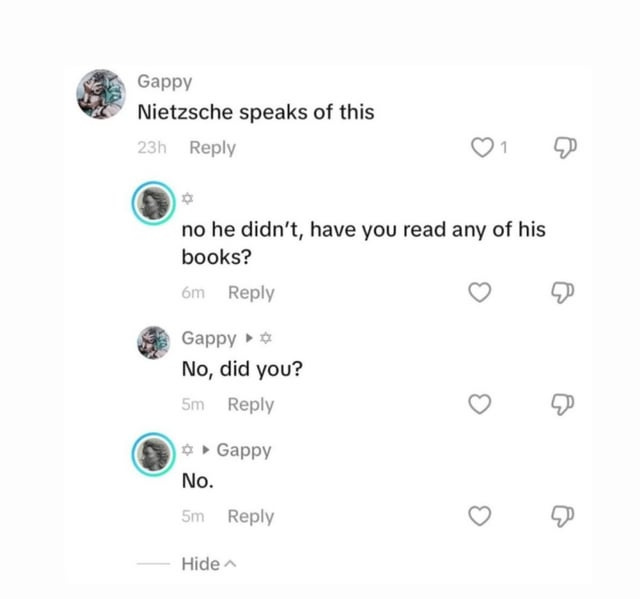
Almost no one reading this knows anything about anything.
Think about the field you know the most about. Now think about how people routinely have opinions on things related to this field that they would definitely not have if they knew as much as you do. Now realize there are people in this field who look at you the same way you look at that person.
Almost everyone is utterly clueless.
The wall is completely covered in shit
On the internet, everyone constantly has opinions on things they aren’t experts about. Everyone is just flinging shit at the wall hoping something sticks (especially me).
I long believed this was a good (maybe even optimal) way to learn. I have often said “The fastest way to learn in a community is to be confidently wrong, and have people correct you”
I’m seriously doubting the truth of that now. I think I severely underestimated the value of sitting back and observing.
Should we be doing any of this? Writing blog posts about topics we are not schooled in, where if you were to read everything related to the subjects would almost certainly change your mind.
It feels like a circus act sometimes. It’s certainly fun! I love posting!!! It certainly works to learn new things to a certain extent. Is it optimal for learning? Is it harming the idea of deferring to scientific consensus? Is it harmful to the psyche? Does it routinely piss people off? Did we always use to do this (after all, I have never been an adult in a social-media free environment!)? I don’t know.
A generation raised on “takes”
I was not really “raised” on conversations. I was raised on reddit threads, youtube political debates and twitter threads. Only now am I investigating the effects of this on my psyche. And I’m not sure how much of it I want to get rid of and how much of it is just… *me* now…
So often on the internet it can feel more important to “have a take” than to actually understand the topic at heart. There’s no time for understanding, it’s post post post and then on to the next thing. We’re organizing tests on subjects we don’t understand, grading each other when we aren’t the teacher, only looking at the grade and not the mistakes and then moving on to a completely new subject we don’t understand to do it all over again.
One of my friends who is especially allergic to this “take” culture once shared, ironically, a view of them that made things “click” for me.
Imagine a river, debris floats around in the lake. After a while, the debris settles as sediment. This loop continues for a while and new sediment is built on top of this old sediment.
This is how culture used to work. Culture would build on top of old culture and create something new. With the advent of short form content, social media and the internet more generally, the tides have shifted. Now the river flows much more intensely and there’s no time for debris to settle as sediment at all. Therefore nothing can be built on top of this sediment either. Culture doesn’t get to build on old culture anymore, because of social media bubbles and the speed at which we hop from one to the next, there is no universally agreed sediment anymore. Memes build on memes that build on comments that few have ever seen, only to be abandoned in mere days if not hours. Swept away by the ever-increasing tide of the river. But in this faster river, sediment still forms on occasion. It doesn’t last long of course. This sediment is no longer built upon other sediment but on the rock of the river. Our base human instincts and emotions.
Quick LLM tangent
Remember earlier LLMs? If you were to investigate it about detailed info at something you would consider yourself to be close to expert level on, do you notice how it’s answers are kind of nonsense? (This argument holds for current LLM chatbots but increasingly less so).
The problem is that people routinely ask LLMs expert level questions when they are not an expert in the field themselves, only now you can’t detect at all when it’s telling you something that is horseshit.
This has lead to the idea of “vibe physics”. Lay people thinking they are on the verge of the next sexy physics breakthrough, by chatting with an LLM, when they in fact kind of know nothing.
LLMs never tell you that what you’re saying is stupid and you should not be trying to solve the Riemann hypothesis as an undergrad. It’s always “Interesting!”, “Great question!” or “Wow, great observation“. Encouraging you to have even more “unearned opinions“.
Chatbots behave this way not because its engineers can’t grow an AI that behaves otherwise. I think that they discovered sycophancy boosts engagement, and that’s why we now have LLMs fine-tuned in that way. (but, AI companies don’t release these stats of course ;))
I think sharing an idea you worked hard on is a very vulnerable act. It’s like getting naked for someone. If they go “eeeeeeeeeeew”, that feels really bad. Sycophancy, then, is not a far fetched response to this. This seems to just be, what humans like. This is what keeps us engaged… We seem to like feeling smart.
Maybe it’s just human?
This whole being confident, laying out your case and then being trial by fire judged by other people to determine whether you are right or not…
Is this, in a way, not also what researchers do? A lot of the time someone spends a lot of time on a research paper and then, after peer review, other scientists point out X, Y and Z reason why your hypothesis sucks and your methodology sucks etc… and that’s just how we learn? (I have never researched, in my life by the way, so maybe this is not true at all and I’m full of shit).
It’s hard to get back up if you never allow yourself to fall down.
Now if this system works for academia, the closest thing we have of rigorous pursuit for truth, who am I to criticize this system? Maybe the problem is the lack of hierarchy. Researchers, presidents, lay people and trolls share the same sites now. An endless stream of opinions, only governed by the chaos of recommendation algorithms and peer review by idiots.
We used to chew thoughts a bit more before we posted them online. Maybe discuss with friends first, in a very low stakes environment. maybe we should bring that back.
What now?
Ironically this analogy and article suffers from exactly what I’m criticizing here. I don’t know shit about linguistics, or social interaction, or social cohesion or the numerous other fields and ideas that play into this stuff. But what else can you do? I feel like I must write about things I think about. It satisfies me in some way that I still can’t put a finger on.
At the end of the day, I can’t imagine a future for me where learning doesn’t involve me going out there and having opinions. There’s little point to philosophy for me if I can’t go play with it in my brain afterwards, and make new stuff from it. (Maybe this is why I like ethics so much).
Substack (which has its own issues) has been better than twitter for this I’ve found. The norm of long form content seems to help a lot.
Maybe returning to the social norm of looking down on “oh, you read that on the internet?” would be good. It would be cool if books made a comeback, and if we went back to having accountable, fact-checking journalists. As usual, I can’t provide you answers on what would fix society..
It’s your own personal choice on how you deal with this. And I don’t think I have decided for myself. I think, at the very least, I will start with being more intellectually humble and focus on understanding instead of forming opinions. I’m gonna say “I don’t know” a little more.