
996 probably doesn't work and no one cares
Cold war psychosis is so back

[day 20/30 - epistemic status: I’m not an expert in this field. I construct a narrative that I find plausible. I tried my best to remain truthful but can only do so much for something written in a day]1
After a renaissance of studies into the 4-day workweek broadly supporting the hypothesis that people get about as much work done in 4 days as in 5, the idea of 996 baffles me.
For the uninitiated: 996 is an illegal work schedule that was first popularized in Chinese tech companies. It’s working from 9 in the morning to 9 in the evening, 6 days a week.
Some SF tech startups are apparently proudly adopting this work schedule, with interview quotes that would kill a young European university graduate:
Stebbings says US-based companies and their employees are currently far more enthusiastic about 996 than their European counterparts. “People in Europe seem shocked when you ask them to work the weekend,”
This all got me wondering…
Do people actually get more work done on a 996 work schedule???
It really isn’t self evident, it’s a hidden assumption of linear productivity proportional to days worked.2 I can’t get more than like, 4 hours of deep work done per day? At most? When I ask around people echo this sentiment. And all the 4-day work week research would probably predict that 996 sucks.
So I went to explore the research on 996. I found a lot of studies on work/life balance, and the results were as expected: It’s uhm, not good for your mental health. Deaths from overworking had become so common they had to invent a term for it, Karoshi.3
The academic consensus is pretty clear: if you care at least a little bit about the mental health of workers, don’t do 996. But… what if you don’t care about the workers?
No one seemed to be funding pure productivity research. This is kind of understandable, who wants to be known as the guy who proved that 996 increased worker productivity by 36%…
I went digging, and 48 pages and 3 figures deep in a study on worker productivity vs hours worked, I found this graph4: (as a reminder, 996 is 72 hours)
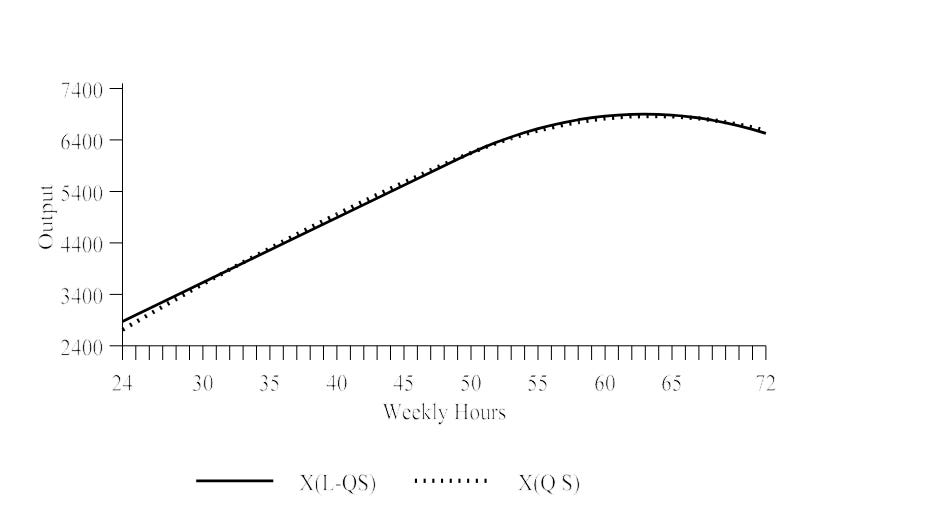
This seems like a huge blow to the 996ers! Total “lazy european” victory!
Mind you: this is across all sectors, maybe tech is different. I don’t think so though, since high-strain cognitive work would intuitively be hit the worst.
You could argue that, in our rational market, if 996 really wasn’t more productive than other work schemes, it would simply die out naturally. Outcompeted by companies who offer workers to get the same shit done in less time with better mental health. This theory falls flat on it’s face when you remember that almost no company deviated from the 5 day work week until research showed that working 4 days could be just as productive.. China had to make 996 illegal for it to stop. And even now it’s still practiced illegally.
Maybe tech companies have internal A/B testing which demonstrated that 996 actually does lead to better outcomes, at least in the short run. I don’t know and I can’t know.
Then.. Why do it?
996 is very likely not more productive, but some tech companies are still doing it.
We are then, left with Rorschach blot. What’s going on here? (opinion ahead, you have been warned)
I think this is cold war-like rat race psychosis. It’s Silicon Valley “move fast and break things” intersecting with employee psychology. It’s the cult of locking in.
There is an inherent human bias against inaction in times of perceived crisis. American AI companies want to “beat china in the race to AGI” so, so badly. Are you really gonna do nothing while China wins? So we work more, work work work until we’re all dead of Karoshi.
After all, China can’t beat us on the benchmarks, it’s holding up the entire American economy…
Not super happy with this one but I knew that this topic would suck me in until the evening if I didn’t press publish.
or at least, the assumption that hourly productivity losses don’t outpace total productivity
This term is japanese, but it’s a widespread thing in asia apparently.
Yes, man of one study, I’m sorry. I think it’s consensus-y though?
My sense is that work hours are not an independent knob that you can adjust simply to optimise efficiency.
A 4-day week and a 996 might be employing two different strategies. A 4-day-week might look like planning logistics carefully to make sure your employees are productive at all times, and that teams who work together can align their off-days to allow work to flow etc. At 996, your strategy probably looks more like is "just get employees to live at work", so you don't have to spend a second thinking about who's available today.
It's like, if you hire a "live-in au pair", this can be basically a 996 job for them, but the logistics might actually be a lot easier (for both parties) than getting the au-pair to do a 9-5 or to come in at various times during the week.
I've had some weeks over the last two years when I worked 996 to produce events, and it's been working pretty well. With the right supportive environment, an upcoming deadline, and a clear set of tasks to do before the event, 996 just feels easy and appropriate. And there was just so much stuff to do, I could not have done it in 965.
Of course, that always required putting a large part of the things I care about on hold, which is why it's always been for at most a month. There's a big difference between having this as your life forever, and knowing it's a temporary intense period which will be followed by appropriate recovery. I think it's reasonable that startup founders could decide to be in this intense production mode for four years, and get back to the rest of their life once the company is sold. They also have a target when they know it will stop.
What seems crazy is offering this to random employees as a baseline, instead of as a specific temporary mode to achieve a specific high reward they care about, after which they can get back to normal hours.